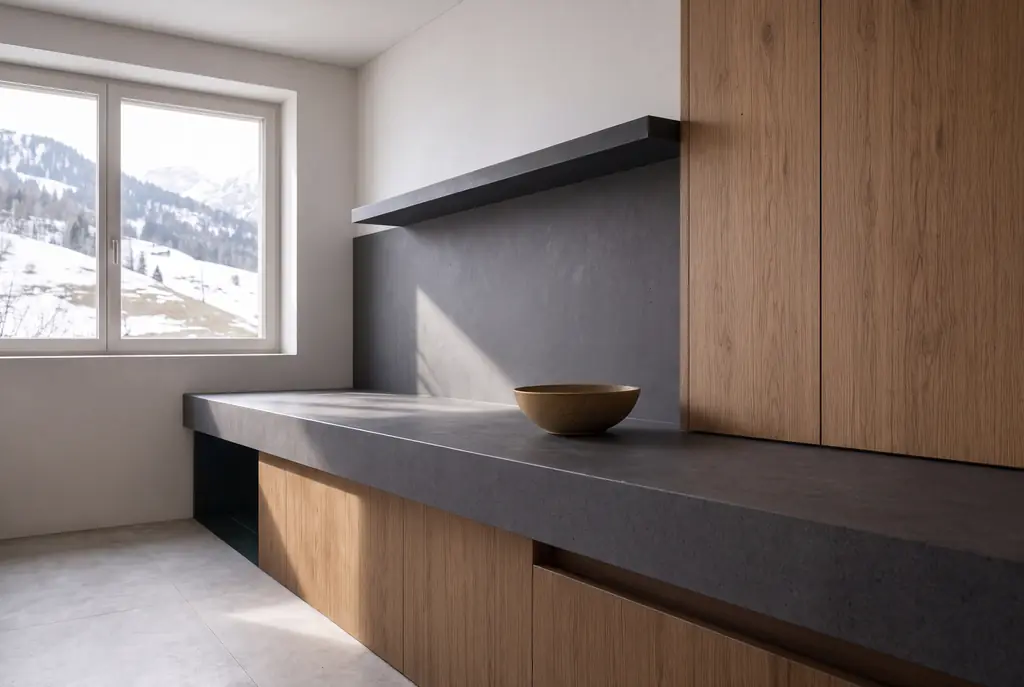
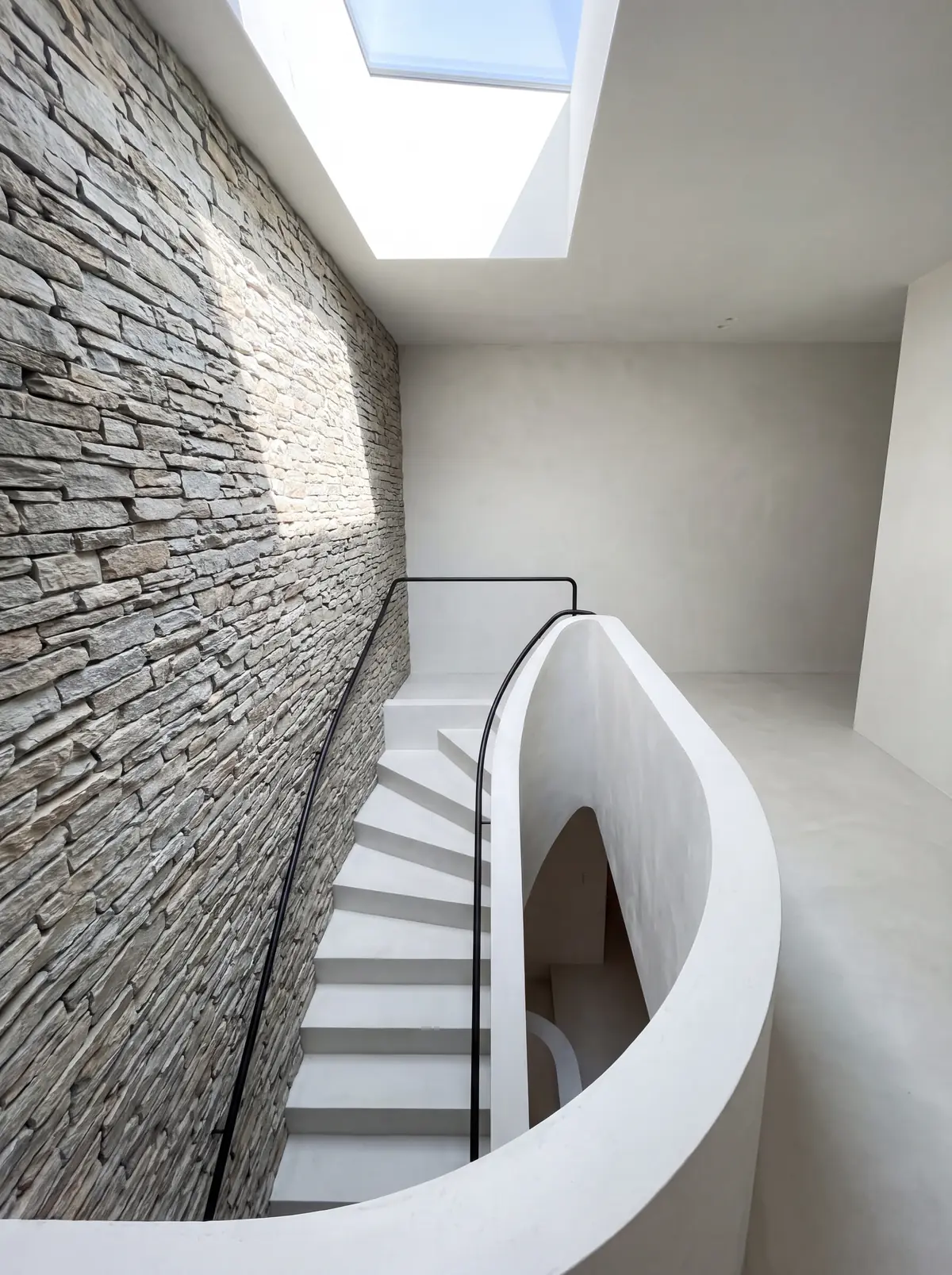
Seamless, not jointless
A continuous surface still has to respect the building. Movement joints in the slab or substrate are carried through the finish, and a good installer raises this at the first site visit. 8
Queenstown, Aotearoa New Zealand · 45.03° S 168.66° E
Seamless microcement in about three millimetres, for floors, walls and bathrooms. Seven finishes coloured after schist, snow, tussock and the lake. Made for Queenstown, Wānaka and Central Otago homes.

The lake, the schist and the snow already do the talking. Microcement lets the floor, the walls and the bathroom fall quiet: one continuous, hand-trowelled surface with no grout lines, so the eye goes out through the glass.
It is a thin, cement-based coating, about two to four millimetres depending on the system, that goes over many sound surfaces. That thinness is why it suits renovating a tired tiled bathroom.2, 5
A continuous surface still has to respect the building. Movement joints in the slab or substrate are carried through the finish, and a good installer raises this at the first site visit. 8
Typical systems sit around 2–4 mm, so floor levels barely move at doors and thresholds. The substrate must be sound, dry and stable. Timber floors are allowed by some systems and ruled out by others.2, 5, 6
At about 3 mm it adds almost no insulation between a heated slab and your feet, and it is widely used over underfloor heating. That matters on a cold Zone 6 morning.2, 21
At Queenstown’s latitude the midwinter noon sun sits only about 21° above the horizon, and the midsummer noon sun about 68°. Low light rakes across a trowelled surface and shows every pass of the steel. High light flattens it. Drag the sun, or pick a moment.
A screen simulation of how raking and overhead light change a trowelled surface. Real colour, grain and sealer sheen will differ, so view physical samples in your own room. Sun angles are calculated for latitude 45° S (90° − 45° ± 23.4°) at solar noon; mountains and ridgelines can block midwinter sun entirely.
Installers commonly put cracked heated floors down to a slab that was not cured, not commissioned, or warmed up too fast. The order of the work matters as much as the finish.
General industry guidance, mostly from installers in other countries. The data sheet and warranty of the specific system, and the heating manufacturer’s commissioning schedule, always take priority. 21, 2
Time → · schematic, not to scale
Before any microcement: take the heated screed through a full, staged heat-up and cool-down, as the heating manufacturer specifies. This drives out moisture and shows up movement early.
Let the screed cool, then check its moisture content with a proper meter. Do not guess. A wet screed is the most common cause of later trouble.
Primer, fibreglass mesh, base coats, finish coats and sealer, with the heating off and the room within the system’s allowed temperature range.
The sealer keeps curing for weeks. Leave the heating off until the manufacturer’s minimum cure time has passed.
Turn it back on in small daily steps, never cold to warm overnight. After that the floor takes normal thermostat use.
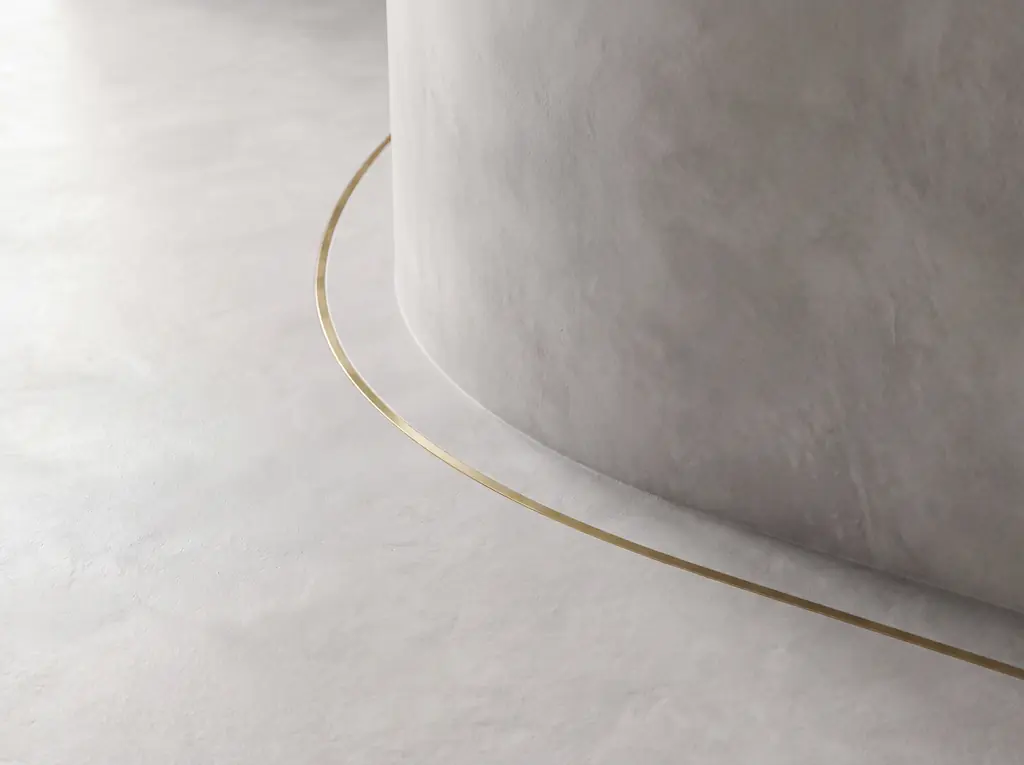
Where a movement joint has to exist, make it a feature. A brass-edged movement-joint profile, set flush in the floor, turns an unavoidable line into the one deliberate detail in the room.
That is the brand’s one rule of ornament: no pattern, no grout, no stencil. Just the surface, the light and, at most, a single thread of brass. Specify the profile with the installer, because a rigid strip laid over a joint would defeat it.

Tell us about the room, the surface underneath and the finish you are drawn to.